
An Important George I Period Gilt Gesso Side Table
Irish, circa 1722
REF1161
An Important George I Period Gilt Gesso Side Table
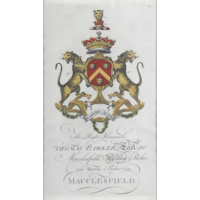
Probably commissioned to celebrate the marriage of Thomas Parker 2nd Earl of Macclesfield to Mary Lane in 1722
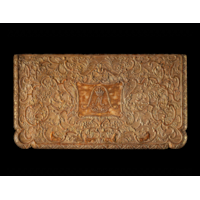
The top bearing the Arms of the Earl of Macclesfield and interlocking ‘Ls of his bride,Mary Lane.
Irish, circa 1722
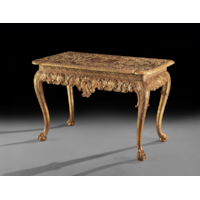
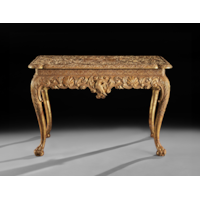
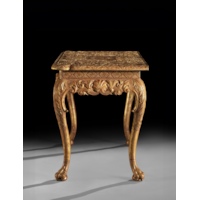
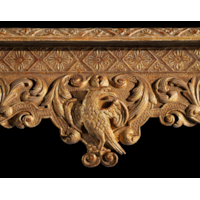
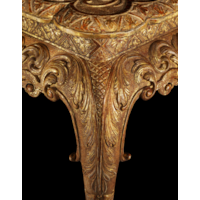
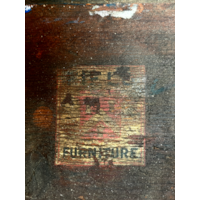
The rectangular moulded top with inset rounded corners to the front, with an elaborately incised decoration of strapwork, flowers and scrolling leaves, with stags and deerhounds, centred by cartouche with ‘M’ for Macclesfield headed by a coronet and with two interlocking ‘L’s for Mary Lane. The base similarly carved with scallop shells, acanthus foliage and centred by an eagle. The four cabriole legs with acanthus foliage to the knees and terminating in paw feet. The base with label bearing the Macclesfield Coat of Arms.
Dimensions:
Width: 49 ó in (126 cm), Depth: 27 in (68.5 cm), Height: 33 in (84 cm)
PROVENANCE
Thomas Parker 2nd Earl of Macclesfield
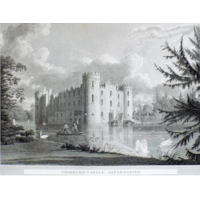
Shirburn Castle, Oxfordshire
 PRINT
PRINT SHARE
SHAREDESCRIPTION
The form of this fine table with its eagle and shell decorated frieze, large overhanging gesso top with armorial decoration and finely incised dogs, stags and scrolling foliage, relates closely to a table illustrated by Herbert Cescinsky in his English Furniture of the Eighteenth Century Volume II, Fig. 128; this table, has precisely the same design of table frame and the top incorporates all the same decorative motifs, apart from having an abstract design in the central cartouche rather than the heraldic work on our table. The Cescinsky piece also has a much greater overhang on the top which makes it look a little unbalanced by comparison.
Heraldic furniture is always of particular interest but deciphering the decoration on our piece required a combination of close examination of the top and the fortunate survival of a label applied to the underside of the frame.
The coat of arms on the label shows a red (gules in heraldic terms) shield, divided by a gold (or) chevron and with three leopard's heads. These are the arms of the Parker family. This ties in perfectly with the Earl's coronet and italic M on the tabletop as the Parkers of Shirburn Castle in Oxfordshire were Earls of Macclesfield.
The cartouche on the tabletop incorporates interlaced Ls. These are likely to refer to the marriage in 1722 between the 2nd Earl of Macclesfield and Mary Lane, the daughter of a wealthy merchant dealing in oriental goods. Gesso pieces of this sort were often commissioned to mark important events and so this tabe is entirely consistent. The 2nd Earl would only have been a Viscount at this stage, but it is likely that the table would have been commissioned as a statement for the future and there are countless examples of noble families bending or rather breaking heraldic rules in this way.
This magnificent side table was therefore, most likley commissioned to mark the marriage of Thomas Parker 2nd Earl of Macclesfield, Lord High Chancellor of Great Britain to Mary Lane on 18th September 1722. Strong stylistic elements of this table would suggest it was made in Ireland. It is highly probable therefore, that it was a gift from Sir Richard Levinge, The First Earl of Macclesfield’s first cousin, to celebrate his sons marriage to Mary Lane. Sir Richard Levinge was an Irish politician and Judge who was Solicitor General for Ireland and lived at Knockdrin Castle, County Westmeath.
Although serving as an MP for his family's Wallingford (Oxfordshire) constituency between 1721 and 1732, George Parker's (2nd Earl of Macclesfield's) true interest was in science. A pioneering aristocratic Fellow of the Royal Society, he had a laboratory built at Shirburn Castle where he continually ran experiments. He was also one of several prominent scientists and intellectuals who campaigned to move Britain over to the Gregorian calendar in 1752. In this same year, Parker became President of the Royal Society, a position he would hold until his death 12 years later.
Aside from science, Parker was a principled man, acting as vice president of London's Foundling Hospital, dedicated to raising abandoned children.
YOU MAY ALSO LIKE

An Important George I Period Gilt Gesso Side Table