

A George II Carved Giltwood Side Table
English, circa 1740
REF1132
A George II Giltwood Side Table
Attributed to John Channon
English, circa 1740
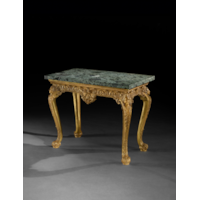
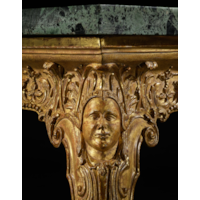
The rectangular ‘Verde Antico’ marble top over a deeply carved frieze of acanthus leaves and flowers, with beaded astragal moulding, centred by a foliate cartouche with ‘venus’ shell. The four cabriole legs headed by finely carved heads with plumed helmets over knees of scrolling acanthus and terminating in scrolled feet.
Height: 32 ¾ in (83.5cm), Width: 41 in (104cm), Depth: 23 in (58.5cm)
PROVENANCE
This outstanding gilt wood side table can be confidently attributed to John Channon (d.1779). A comparative table but in padouk wood with similar helmeted heads and central cartouche was once in the collection of the late Mrs. E.I.F. Barran of Shadwell Grange, Leeds, Yorkshire. This table was sold at Christie's in New York in 1999 for $ 167,500.
 PRINT
PRINT SHARE
SHAREDESCRIPTION
Following London's rapid expansion westwards into Mayfair in the early 18th Century, John Channon took the opportunity to move from his family's cabinet-making business in Exeter and establish workshops in St. Martin's Lane, London which was becoming the centre of England's cabinet-making industry. He was given encouragement by his Devon patron, Sir William Courtenay, 1st Viscount Courtenay (d. 1762) following his succession to the Powderham Castle estates in Devon in 1736.
John Channon is documented as working at 109 St. Martin’s Lane from 1737. He is celebrated for a remarkable group of case furniture distinguished by engraved brass inlay, elaborate Rococo mounts and sinuous outlines; inspired by Continental prototypes and often employing exotic woods such as padouk.
This example shows notable parallels in construction, decoration and mounts to the spectacular pair of padouk bookcases with Braint-inspired brass inlay at Powderham Castle, Devon, each bearing a brass tablet engraved “J Channon Fecit 1740” (see C. Gilbert and T. Murdoch, op. cit., pl. XXIII). These bookcases remain the only signed or labelled examples of Channon’s work.
Another masterpiece by Channon, unsigned but confidently attributed, is the celebrated “Fonthill Splendens” dressing commode, almost certainly supplied along with its pair (now in the Victoria and Albert Museum, London) to William Beckford. Sold by the late Michael Behrens, Esq. at Christie’s London on 6 July 1989 (lot 163), it achieved a record price and was for many years the most expensive piece of English furniture sold at auction.
The legs of this table are carved in the manner of French fashioned brass enrichments, with Roman acanthus cartouches adorned with plume-helmeted heads of Mars. These appear on palm wrapped, flower trellised brackets and are accompanied by triumphal Venus shells. This taste for boulle-style ornament drew heavily from Continental designs, which were readily accessible to London cabinetmakers. Among the influential sources were Gaetano Brunetti’s Sixty Different Sorts of Ornaments (published in London, 1736) and P. Babel’s A New Book of Ornaments (1752).
The leg ornament itself, however, derives from designs in B. Toro’s Masks and Other Ornaments, published in London in 1745 (E. White, ed., Pictorial Dictionary of British 18th Century Furniture Design, Woodbridge, Suffolk, 1990, p. 399, pl. 5). These distinctive heads and foliate lion-paw feet also appear on a closely related writing table, also attributed to Channon and formerly in the collection of Leonard Knight (C. Gilbert and T. Murdoch, op. cit., p. 83, pl. 86). Their exact profile and form channelled in the bronze mounts embellishing the cabinet-on-stand by Channon now in the Bristol Museum and Art Gallery.
YOU MAY ALSO LIKE


A George II Carved Giltwood Side Table