
Victor Pasmore
(1908 - 1998)
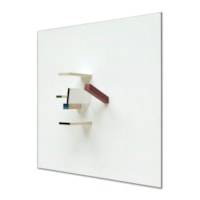
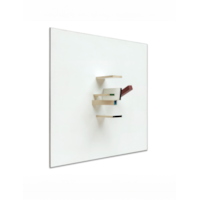
Abstract in White, Black, Maroon and Indigo, 1963
Abstract in White, Black, Maroon and Indigo, 1963
Projective relief in mixed media
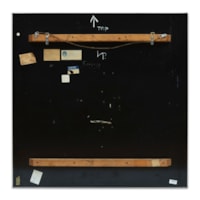
signed with initials 'VP.' (verso)
First spatial projection relief of this kind with deeply projecting elements clustered towards the centre and set at angles which depart from the orthogonal was Relief construction in white black and cedar of 1960-61.
The suggestion of geometric forms floating in space, which is created by the coloured top surfaces of the projecting elements, derives from the signboards and posts seen against mist in the paintings of the Thames Chiswick. The physical, coloured posts in the Thames serve simple navigational purposes but, aesthetically, they present stark geometric forms and colours against the organic, fluctuating environment of the water. This directly mirrors the constructivist ethos of placing hard-edged, geometric, and rationally chosen forms into a dynamic space.
Height: 48 1/4 in (122.5cm) Width: 48 1/8 in (122.2 cm) Depth: 12 1/8 in (31cm)
PROVENANCE
The Artist's Estate
Marlborough Fine Art, London, where acquired by Private Collection, South America
 PRINT
PRINT SHARE
SHAREDESCRIPTION
In the early 1960s, Victor Pasmore produced some of his most radical abstract works. Having abandoned figurative painting in favour of geometric abstraction in the late 1940s, he developed a series of relief constructions that extended painting into three dimensions. Abstract in White, Black, Maroon and Indigo exemplifies this phase of his practice, in which carefully arranged geometric elements explore the relationships between form, space and colour.
Separated from the cluster of green, indigo and black shapes, stands a maroon block protruding diagonally and upwards, introducing a strong visual contrast and interrupting the otherwise compact arrangement.
The large white ground plays an important role in the composition. Its expansive empty surface creating a sense of clarity and calm, allowing the small geometric elements to appear almost suspended within the pictorial field. At the same time, the projecting forms cast intersecting shadows that emphasise their physical presence and draw attention to the depth of the construction.
Pasmore viewed these constructions as experimental investigations into the language of pure form. He described relief construction as "an experimental development intended to extend the reality of flat painting," the aim being to create optical ambiguity and encourage the viewer's eye to move beyond the boundaries of the rectilinear format (letter to Leif Sjoberg, 1987). Closely aligned with ideas of modern technology and architecture, these works function not as representations of the visible world but as carefully structured arrangements of form. Through its restrained palette and balanced composition, Abstract in White, Black, Maroon and Indigo demonstrates this approach with particular clarity, inviting the viewer to reconsider the pictorial plane as an active spatial field in which colour, structure and depth interact.
LITERATURE
Alan Bowness and Luigi Lambertini (int.), Victor Pasmore, with a Catalogue Raisonné of the Paintings, Constructions and Graphics 1926-1979, Thames and Hudson, London, 1980, cat.no.285 (ill.b&w)
Tate gallery catalogue of Victor Pasmore’s retrospective exhibition 14-27th June 1965 Arts Council of Great Britain 1980, Victor Pasmore
EXHIBITION
London, Tate Gallery, Victor Pasmore: Retrospective Exhibition 1925-1965, 14 May-27 June 1965, cat.no.176 (as Projective Relief in White, Black and Maroon)
São Paulo, Ciccillo Matarazzo Pavillion, VIII Bienal de São Paulo, organised by the British Arts Council, 4 September-28 November 1965, cat.no.20 (as Projective Relief in Black,
White, Reddish-brown, and Indigo)
London, Annely Juda Fine Art, The Non-Objective World 1914-1955, 2 July-22 September 1973, cat.no.108
Bradford, Cartwright Hall, Victor Pasmore, 2 February-9 March 1980, cat.no.27
(as Projective Relief); this exhibition travelled to Liverpool, Walker Art Gallery, 15 March-May; Norwich, Sainsbury Centre, UEA, 20 May-15 June; Leicester, Leicestershire Museum and Art Gallery, 21 June-20 July; Newcastle upon Tyne, Laing Art Gallery, 26 July-25 August; London, Royal Academy, 13 September-19 October
São Paulo, Dan Galeria and Centro Brasileiro Britânico, Concretos Paralelos / Concrete
Parallels, 4 September–2 December 2012 (exhibition unnumbered)
ARTIST'S BIOGRAPHY
Victor Pasmore (1908 – 1998) was born in Chelsham, Surrey, the son of a well-known physician and mental specialist and an amateur painter. He was educated at Harrow School where he first became seriously interested in painting. Following the sudden death of his father he had to abandon his studies at the Central School of Arts and Crafts where he had studied under A. S. Hartrick, an artist who had worked in France and who knew van Gogh. Pasmore, who had expected to go Oxford and then on to The Slade School of Art, now had to find employment as a clerk in the Public Health Department in London instead, a job he held until 1937. During this time he joined the London Artists’ Association and had his first solo exhibition at their Cooling Galleries on Bond Street in 1933. In 1937 Pasmore left the Public Health Department and formed an independent art school with fellow artists Claude Rogers, Graham Bell and William Coldstream in Fitzroy Street. The school’s first show in 1938 coincided with its move to 316 Euston Road which led to the art critic Raymond Mortimer to identify them as the Euston Road Group. Pasmore himself moved to a studio at 8 Fitzroy Street, formerly occupied by Sickert and Whistler, and spent his time teaching and painting. Pasmore was Director of Painting at Camberwell School of Art from 1941 to 1949 when he moved on to The London County Council Central School of Arts and Crafts where he introduced a basic form course. He went on to teach art at Durham University, Leeds College and Newcastle University until 1960 when he decided to finish his teaching career and take up full time painting. Pasmore abandoned visual representation and developed a purely abstract style in 1947. His work, often in collage and construction of reliefs, pioneered the use of new materials and was sometimes on a large architectural scale. He held his first abstract solo exhibition at the Redfern Gallery, London, in 1948. Herbert Read, an important art critic of the time, described Pasmore's new style as 'The most revolutionary event in post-war British art'. In the summer of 1950 he visited St Ives where he became associated with Ben Nicholson and Barbara Hepworth and joined the Penwyth Society, the local exhibiting group. Pasmore was a trustee of the Tate Gallery, donating a number of works to the collection. He gave a lecture on J.M.W.Turner as 'first of the moderns' to the Turner Society, of which he was elected a vice-president in 1975. His work has been exhibited widely all over the world including representing Britain in the Venice Biennale in 1960 and the Sao Paulo Biennale in 1965, the International Art Exhibition in Tokyo, Documenta II in Kassel, Germany and the travelling exhibition “British Art Today” in the U S A. In more recent years retrospectives have been held at Marlborough Fine Arts in London and at the Serpentine Gallery, London, in 1991. Victor Pasmore has also had paintings included in the “Changing the Process of Painting” Exhibition at the Tate Gallery, Liverpool in 1999.
YOU MAY ALSO LIKE
Victor Pasmore
Abstract in White, Black, Maroon and Indigo, 1963