

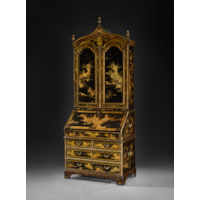

A GEORGE II PERIOD LACQUER BUREAU CABINET
Made in China, probably Canton circa 1740
REF1131
A Rare George II Period Lacquer Bureau Cabinet
Made in China, probably Canton circa 1740
The upper section headed by a serpentine shaped cornice, retaining three original finials and centered by a vase of flowers, over a pair of panelled doors, finely lacquered with mountainous scenes of villages and pagodas in a watery landscape, opening to reveal a complex arrangement of drawers, pigeonholes and adjustable shelves all finely lacquered with flowers and foliage. The lower section with fall, again finely decorated with islands, bridges and pagodas, opening to reveal a fitted interior with a central door, surrounded by drawers and pigeonholes. The two short and two long drawers with moulded borders all decorated with finely detailed scenes of temples
and villages. The sides similarly decorated. Raised on bracket feet.
Height: 102 inches (260 cm), Width: 40 1/2 inches (102.5 cm), Depth: 24 1/2 inches (62 cm)
 PRINT
PRINT SHARE
SHAREDESCRIPTION
This extraordinary bureau cabinet is a particularly rare and fascinating example. The quality and detailing of the lacquer created in China was considerably finer than anything craftsmen in England could achieve and so this cabinet would have been a highly prized and exotic acquisition.
The art of lacquering originated in China with the discovery of the protective properties of the sap of the lacquer tree ‘Rhus verniciflua’. When applied to wood or metal, the sap forms a hard, durable semi-transparent film which can then be used to coat the surface of most materials. The benefit of the lacquer is that besides being a preservative it provides a smooth surface which can then be coloured, painted and gilded on. Europe, towards the end of the 17th Century, and throughout the 18th Century, became fascinated by all goods associated with China and so many such goods began to be imported into the West. Organisations such as the East India Company commissioned labourers in China to produce Chinese designs, but in the style of the West. The result was bureau-cabinets of this style with Chinese scenery, frequently being imported into England; the first recorded import of lacquer ware by the East India Company taking place in 1683. By the 18th Century many countries in Europe began to devise methods of imitating oriental lacquer, known as Japanning. The main ingredient of the lacquer was not available in Europe so, European imitations were made of gum-lac, seed-lac or shell-lac. The finest examples are difficult to distinguish from true lacquer although the decorations (which are often Chinoiserie) usually give them away. Stalker and Parker are believed to have been two of the leading craftsmen in the art of Japanning having written A Treatise of Japanning and Varnishing, Oxford, 1688, which describes the various ways of imitating Japanese lacquer.
YOU MAY ALSO LIKE

A GEORGE II PERIOD LACQUER BUREAU CABINET