

AN EARLY EIGHTEENTH CENTURY SIDE TABLE
English, circa 1740
REF1042
A Rare Early Eighteenth Century Side Table
English, circa 1740
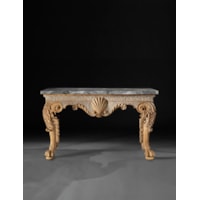
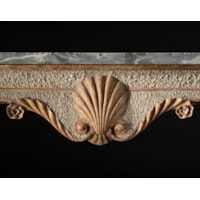
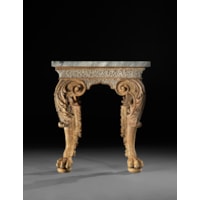
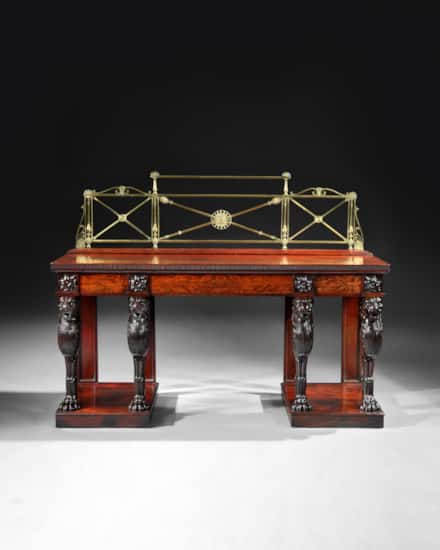
The original rectangular Bardiglio marble top over a cavetto frieze, applied with a rustic stone ground. The deep frieze centred by a large scallop shell and flanked by scrolling leaves. The four boldly shaped legs carved with scrolls and acanthus leaves over paw feet.
Height: 34 in (88cm), Width: 58 1/4 in (148 cm), Depth: 30 1/2 in (77.5cm)
This magnificent side table displays many similarities to a pair of side tables in the Metropolitan Museum of Fine Art in New York. These tables relate to an unfinished drawing by the designer and carver Matthias Lock (ca. 1710-1765) in the Victoria and Albert Museum, London. Although Lock is best known for his designs in an English version of the French Rococo style, this drawing is in the bold manner associated with the English Palladian movement, propagated in early eighteenth-century England by the architect and designer William Kent and his patron Lord Burlington. This architectural style also affected furniture design. Characteristic of this are the large shell motifs, lion's paws and curling acanthus leaves seen here.
Particularly unusual here is the varied surface treatment of this table. The water gilding, now carefully taken back to the original, as seen on the central shell and acanthus and also on the scrolling of the legs and carved acanthus at the knees of the cabriole legs and paw feet, contrasts strongly with the painted coarse stone ground of the reserves. The combination of the central shell and coarse ground are highly reminiscent of the fashion for ‘Grottos’ popular in grand country houses in the early eighteenth century.
PROVENANCE
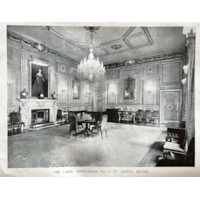
Lord and Lady Astor. 4 St James’s Square London.
Illustrated in The Antique Collector. February 1940. Photographed in The Large Dining Room.
 PRINT
PRINT SHARE
SHAREDESCRIPTION
Lord and Lady Astor of 4 St James’s Square
At the distinguished address of 4 St James’s Square, Lord and Lady Astor carved out a
prominent social and political presence in early 20th-century London.
The Astors, heirs to both American wealth and British aristocracy, made their home not merely a residence but a nexus of influence and intellect.
Lord Astor, William Waldorf Astor, was a financier, newspaper proprietor, and peer who
became a powerful figure in British high society after relocating from the United States. His son,Waldorf Astor, and daughter-in-law, Nancy Astor, would go on to define the family’s legacy in politics and society. Nancy, in particular, was a trailblazer—becoming the first woman to take a seat in the British Parliament in 1919.
At 4 St James’s Square, receptions, salons, and informal gatherings brought together
statesmen, writers, and thinkers. The house, grand and Georgian, stood as a symbol of
transatlantic ambition and modern political change. It was not just a home, it was a stage for history.
YOU MAY ALSO LIKE


AN EARLY EIGHTEENTH CENTURY SIDE TABLE